
ED
Editor-in-Chief

Journal of Digital Interdisciplinary Global Islamic Thought
| Journal Title | DIGIT: Journal of Digital Interdisciplinary Global Islamic Thought |
|---|---|
| Editor-in-Chief | Dr. Abdul Muiz Amir, Lc., M.Th.I.SCiDGSSI |
| Managing Editor | Muhammad Iqbal, Lc., M.HI.SCiDGSSI |
| Publisher | WIN-MANGAJI |
| Institution/Society | WARAQAT INSANI NUSANTARA (WIN) |
| Publisher Address | Jl. KS. Tubun, Rajawali Residence, Baruga, Kendari, Sulawesi Tenggara, Indonesia |
| Editorial Office | Jl. KS. Tubun, Rajawali Residence, Baruga, Kendari, Sulawesi Tenggara, Indonesia |
| Official Email | digit@win-mangaji.id |
| Website | https://win-mangaji.id/index.php/digit |
| e-ISSN | TO BE REGISTERED |
| p-ISSN | TO BE REGISTERED |
| DOI Prefix | [CROSSREF PREFIX] |
| Publication Model | Open Access |
| Publication Frequency | Two regular issues annually, June and December |
| Language | English |
| Peer Review | Double-blind external peer review |
| Copyright / Licence | CC BY 4.0 |
| Digital Preservation | [ACTIVATE BEFORE LISTING] |
| Originality Screening | Editorial assessment supported by similarity-detection software |
About, mission, aims, scope, readership, article types, language, style, and publication schedule.
DIGIT: Journal of Digital Interdisciplinary Global Islamic Thought is an international peer-reviewed journal devoted to the study of Islam in relation to digital technologies, media, computational practices, and emerging technological environments.
The journal begins from the premise that digital technologies are no longer external instruments through which religious ideas are simply communicated. Platforms, algorithms, artificial intelligence, databases, computational infrastructures, and networked media increasingly participate in the conditions under which religious knowledge is produced, circulated, interpreted, authorized, contested, archived, and experienced. These developments raise questions that cannot be adequately addressed within the boundaries of a single discipline. A fatwa that migrates from the mosque to a livestream, for instance, does not simply reach a wider audience; it acquires new forms of authority, contestation, and permanence that textual jurisprudence alone cannot explain.
DIGIT therefore brings Islamic Studies into sustained conversation with Religious Studies, Media and Communication Studies, Digital Humanities, Anthropology, Sociology, Science and Technology Studies, Information Studies, Education, History, Philosophy, Law, and related fields. Its purpose is not to gather disparate studies under the broad label of “Islam and technology,” but to publish research in which the relationship between Islam and digitality constitutes a substantive scholarly problem.
The term Islamic thought is used here in an intentionally capacious sense. It encompasses formal intellectual traditions—Qurʾanic interpretation, hadith, theology, philosophy, jurisprudence, ethics, and political thought—as well as the wider processes through which Islamic knowledge, norms, arguments, identities, and forms of authority are produced and negotiated in social life. DIGIT is consequently interested both in the digitization of established Islamic traditions and in the ways digital environments generate new forms of religious reasoning, authority, practice, and public engagement.
The journal also encourages inquiry in the opposite direction: research that asks what Islamic intellectual, ethical, and legal traditions may contribute to contemporary discussions of artificial intelligence, automation, surveillance, privacy, algorithmic governance, data justice, and technologically mediated forms of human agency.
DIGIT is global in orientation. It welcomes scholarship from and about Muslim societies in Asia, Africa, the Middle East, Europe, the Americas, Oceania, and transnational or diasporic contexts. Studies rooted in a particular locality are welcome when they address questions capable of speaking to wider theoretical, comparative, methodological, or empirical debates.
The journal seeks scholarship that is conceptually rigorous, methodologically transparent, critically engaged with relevant international scholarship, and explicit about its contribution to existing knowledge.
DIGIT seeks to establish Digital Islamic Studies as a rigorous field of interdisciplinary inquiry rather than as a loose collection of studies concerning Muslims’ use of technology.
Its editorial mission is to develop scholarship capable of explaining how digital infrastructures alter Islamic knowledge and authority; how Muslim actors appropriate, negotiate, resist, or reshape technological systems; how computational methods create new possibilities and problems for the study of Islamic texts and societies; and how Islamic intellectual traditions may inform critical debates concerning technological futures.
The journal gives particular attention to scholarship that connects textual and social-scientific research, develops theoretically informed accounts from contexts that remain underrepresented in international scholarship, and moves beyond technologically deterministic or purely descriptive accounts of religious change.
DIGIT does not privilege a particular theological, ideological, denominational, political, or methodological orientation. Editorial decisions are based on scholarly relevance, originality, methodological and argumentative quality, research integrity, and contribution to the journal’s field.
DIGIT aims to advance interdisciplinary scholarship on the relationship between Islam and digital transformation; develop Digital Islamic Studies as an internationally established field of research; facilitate meaningful exchange between textual, historical, philosophical, computational, and social-scientific approaches; broaden international discussion by bringing scholarship from different regions and intellectual traditions into conversation; encourage responsible methodological innovation in digital and computational Islamic Studies; support critical research on artificial intelligence and emerging technologies from Islamic and comparative perspectives; and publish scholarship that makes an identifiable contribution to theoretical, methodological, historical, or empirical knowledge.
The journal is particularly interested in research that does more than document the presence of technology in Muslim settings. Successful submissions should explain why the digital dimension matters analytically and how the findings revise, extend, challenge, or refine an existing scholarly discussion.
DIGIT publishes research on the production and circulation of Islamic knowledge through digital environments. Relevant subjects include online religious authority; ʿulamāʾ and digital publics; preachers and religious influencers; online fatwas; digital daʿwa; platform-mediated religious expertise; contestation over authenticity and credibility; misinformation and religious knowledge; changing relations between institutions, scholars, algorithms, and audiences; and emerging forms of machine-mediated religious authority.
The journal welcomes critical research on generative artificial intelligence, large language models, algorithmic recommendation, automated decision-making, conversational agents, machine-generated religious content, algorithmic bias, AI-mediated interpretation, and the ethical and epistemological problems that arise when computational systems participate in the production or communication of Islamic knowledge.
Work in this area should ordinarily engage both relevant technological developments and substantive scholarship in Islamic Studies, Religious Studies, ethics, philosophy, law, communication, or society.
DIGIT provides a venue for research on digital Qurʾanic studies, digital tafsir, computational analysis of Qurʾanic and hadith corpora, textual databases, natural-language processing, manuscript digitization, digital philology, corpus linguistics, semantic analysis, manuscript comparison, visualization, and computational approaches to Islamic textual traditions.
The use of a digital tool alone does not constitute sufficient novelty. Computational and digital methods must enable a substantive research question and produce a contribution relevant to the underlying field of scholarship.
The journal welcomes theoretically informed uses of text mining, network analysis, computational linguistics, geographical information systems, digital mapping, machine learning, bibliographic data, database construction, visualization, digital archival research, and related techniques.
Studies should document datasets, corpora, software, computational procedures, model versions, and analytical decisions with sufficient clarity to permit scholarly evaluation and, where ethically and legally possible, reproducibility.
DIGIT considers research on social media, streaming media, podcasts, online video, gaming, memes, digital aesthetics, visual culture, online communities, digital rituals, mediated piety, religious representation, celebrity and influencer cultures, popular Islam, online activism, polarization, and platform cultures.
The journal is particularly interested in work that explains the institutional and algorithmic properties of platforms rather than treating social media as a neutral setting for data collection.
Relevant research may examine digital identity, gender, youth, migration, citizenship, family, minority communities, politics, social movements, religious organizations, everyday practice, transnational networks, consumption, or public life where digital infrastructures are integral to the research problem.
The presence of Muslim respondents or a Muslim-majority research location is not by itself sufficient to establish fit with DIGIT.
The journal welcomes research on digital Islamic education, online and hybrid religious learning, AI-supported learning, digital pedagogy, educational platforms, new forms of teacher and learner authority, digital literacy, open educational resources, and the institutional transformation of Islamic education.
Generic studies of educational technology without a substantive contribution to Islamic Studies, religion, digital culture, or the relevant international educational literature are outside the journal’s remit.
DIGIT publishes scholarship addressing privacy, surveillance, automation, artificial intelligence, intellectual property, digital property, data governance, digital finance, virtual environments, biotechnology where digitally mediated, human-machine relations, algorithmic justice, and other emerging technological questions from Islamic legal, ethical, philosophical, or comparative perspectives.
Normative argument is welcome when it engages critically with both Islamic intellectual sources and the relevant contemporary scholarly literature.
The journal welcomes research on manuscript digitization, digital preservation, archival infrastructures, cultural heritage databases, virtual museums, computational cataloguing, access to Islamic collections, digital repatriation, and the politics of digitizing religious and cultural heritage.
Comparative work across countries, languages, platforms, Islamic traditions, institutions, or Muslim communities is particularly encouraged. DIGIT also welcomes work that critically examines differences in technological access, infrastructure, regulatory regimes, platform governance, and knowledge production between regions commonly described as the Global North and Global South.
DIGIT is not a general Islamic Studies journal. A manuscript concerning theology, Islamic education, Qurʾanic interpretation, Islamic law, politics, economics, or Muslim society must demonstrate why a digital, computational, media, technological, or platform dimension is constitutive of its research problem.
DIGIT is likewise not a computer science or information-technology journal. Articles whose principal contribution is an algorithm, application, software architecture, information system, or technical performance benchmark without a substantial research question concerning Islam, religion, ethics, culture, knowledge, or society fall outside the journal’s scope.
The journal does not ordinarily publish purely descriptive case reports, local surveys lacking engagement with international scholarship, generic bibliometric mapping, uncritical theological exposition, sermons, devotional material, institutional reports, advocacy papers, or manuscripts whose primary purpose is technological promotion.
Bibliometric studies will be considered only when bibliometric evidence is used to answer a substantive intellectual question and is accompanied by interpretation that contributes beyond mapping publication counts, keyword occurrence, or citation networks.
DIGIT is intended for researchers, university faculty, advanced postgraduate students, and research professionals working across Islamic Studies, Religious Studies, Digital Religion, Media and Communication Studies, Anthropology, Sociology, Digital Humanities, Science and Technology Studies, Information Studies, Education, History, Philosophy, Ethics, Law, and related interdisciplinary fields.
A manuscript considered for external review should present a clearly defined research problem; locate that problem within appropriate international scholarship; explain its conceptual or theoretical significance; employ methods appropriate to the research question; provide transparent evidence for its claims; demonstrate that Islam and digitality are substantively rather than superficially related in the study; distinguish the study’s findings from what is already known; and state precisely what the article contributes to scholarship beyond its immediate case.
Novelty alone is not sufficient. DIGIT evaluates whether the contribution is meaningful to the relevant scholarly field.
Research Article. Original scholarly research based on textual, historical, qualitative, quantitative, computational, mixed-method, philosophical, legal, or other appropriate forms of inquiry. Normal length: approximately 7,000–9,000 words excluding references.
Review Article. Critical synthesis of a clearly defined body of scholarship that advances an argument, identifies conceptual or methodological problems, and proposes a meaningful research agenda. Normal length: approximately 8,000–10,000 words. Purely descriptive literature summaries are not suitable.
Methods and Digital Scholarship Article. Research introducing, evaluating, or critically applying a digital or computational method to a substantive problem in Islamic Studies. Normal length: approximately 5,000–8,000 words.
Critical Forum or Scholarly Perspective. Commissioned or selectively accepted interventions into a significant emerging debate. Such contributions must be scholarly and appropriately referenced. Their peer-review status will always be identified transparently on the published article.
Research Articles constitute the principal content of the journal.
DIGIT publishes full research articles in English.
English must be clear, precise, and intelligible to an international scholarly readership. Authors are responsible for the linguistic quality of their submissions. The journal assesses arguments and scholarship rather than native-speaker status and does not discriminate on the basis of linguistic background.
Arabic, Persian, Ottoman Turkish, Indonesian, and other non-Roman scripts may be supplied where academically necessary, but names, bibliographic information, and cited references must also be presented in Roman script.
Non-English titles in reference lists should normally be transliterated and, where useful for international readers, followed by an English translation in square brackets.
Authors whose manuscripts require language improvement are strongly encouraged to use certified professional translation and/or academic proofreading services. Where such a service is used, authors should upload a certificate or statement issued by the service provider as a supplementary file at submission.
Authors who do not have access to an external provider may request optional translation or academic proofreading support arranged by DIGIT. This service is independent of editorial evaluation; fees are based on manuscript word count and the type of language support requested.
DIGIT uses a consistent international system for transliterating Arabic and other languages employing Arabic-derived scripts. The journal will adopt one declared system throughout its publications rather than mixing national and international conventions.
For consistency with international scholarship in Islamic Studies, DIGIT follows the IJMES transliteration conventions, with reasonable exceptions for proper names, geographical names, institutions, and terms established in English usage.
References should follow the current edition of the Chicago Author-Date system unless otherwise specified in the journal’s detailed style guide.
Every Research Article, Review Article, and Methods Article must contain an English abstract of approximately 200–250 words.
The abstract should identify the research problem, relevant context, principal material or data, methodological approach, major finding or argument, and the article’s principal contribution. It should not function merely as an introduction to the topic.
Authors should provide five to seven specific keywords that support international discoverability and are not simple repetitions of words already present in the title.
DIGIT publishes two regular issues each year, in June and December.
Publication dates constitute an editorial commitment. Issues will not be artificially backdated, and articles will not be assigned to an issue dated earlier than their actual publication.
The journal will maintain a publication volume that is sustainable within its editorial and peer-review capacity. An increase in frequency will occur only when submission quality, reviewer capacity, production resources, and editorial workload demonstrate that a higher frequency can be maintained without weakening review standards.
Peer review, editorial independence, governance, board diversity, editor submissions, and special issues.
All Research Articles, Review Articles, and Methods and Digital Scholarship Articles undergo external peer review before publication.
DIGIT employs a double-blind review system in which the identities of authors and reviewers are concealed from one another during the review process. Each research manuscript normally receives reports from at least two independent reviewers with relevant subject expertise.
Submission does not imply acceptance.
Following submission, the editorial office conducts an administrative check for completeness, authorship information, ethical declarations, manuscript anonymization, and compliance with journal requirements. A handling editor then conducts a substantive editorial assessment of scope, scholarly relevance, originality, methodological adequacy, argument, and likely contribution.
A manuscript may be declined without external review when it falls outside the journal’s scope, does not meet the expected academic standard, lacks a sufficiently developed research problem, offers primarily descriptive findings, contains substantial ethical or integrity concerns, or is unlikely to make a contribution to DIGIT’s readership.
Manuscripts that proceed are assigned to reviewers selected for demonstrated expertise. Reviewers should be independent of the authors and should not have relationships that could reasonably compromise impartiality. Reviewers should not normally be employed by the same institution as any author, have an immediate supervisory relationship with an author, or have recent research collaborations that create a competing interest.
Editorial decisions may include rejection, major revision, minor revision, or acceptance. A request for revision does not constitute a commitment to publish. Revised manuscripts may be returned to the original reviewers when further specialist assessment is necessary.
Where reviewer reports conflict substantially, the handling editor may seek an additional review.
The final decision is made by the responsible editor on the basis of the manuscript, reviewer reports, author responses, ethical considerations, and the journal’s editorial standards. Reviewers advise; editors decide.
DIGIT does not permit reviewers to require citation of their own work, the handling editor’s work, or articles from DIGIT unless those references are genuinely necessary to the scholarly argument.
The journal does not guarantee a predetermined review or acceptance time. Once sufficient publication data are available, DIGIT will report actual editorial-performance statistics rather than advertise unsupported turnaround claims.
Submission, revision, acceptance, and publication dates are displayed with every published research article.
Editorial decisions are independent of the journal’s owner, publisher, sponsoring institution, funders, advertisers, and administrative authorities.
The publisher provides the infrastructure and resources required to operate the journal but does not determine which individual manuscripts are accepted or rejected.
The Editor-in-Chief has ultimate responsibility for maintaining the journal’s scholarly standards and integrity of the published record, subject to the journal’s declared policies and procedures.
Institutional affiliation with the publisher neither advantages nor disadvantages an author.
DIGIT is governed through a clearly defined editorial structure consisting of an Editor-in-Chief, Managing Editor, Associate Editors with expertise aligned to major areas of the journal’s scope, and an International Editorial Board.
Editors and board members are appointed on the basis of subject expertise, publication record, editorial competence, professional integrity, and capacity to contribute actively to the journal.
The journal publishes the full name, institutional affiliation, country or region, and appropriate persistent researcher identifier or institutional profile for every editor and editorial board member.
Membership is not honorary. Individuals listed on the board must have agreed to serve and are expected to participate in editorial advice, peer-review development, disciplinary guidance, or other defined responsibilities.
Board composition is reviewed periodically to ensure that its scholarly expertise remains aligned with the actual content of the journal and that its geographic and disciplinary composition reflects DIGIT’s international scope.
DIGIT seeks substantive rather than symbolic internationalization.
Geographic diversity is pursued through the appointment of scholars whose research records demonstrate relevant expertise across different regions and intellectual traditions. The board should not be dominated by a single institution, country, or professional network.
International diversity will not be created through nominal appointments. Each member’s publication record and academic profile should be consistent with the field represented in DIGIT.
The journal similarly monitors the institutional and geographic distribution of published authors. Editorial decisions remain merit-based, and geographic diversity is never used to override research quality.
Editors and Editorial Board members may submit manuscripts to DIGIT, but they receive no preferential treatment.
An editor who is an author, co-author, recent collaborator, supervisor, institutional colleague where a material conflict exists, or otherwise has a competing interest in a submission will have no role in its review or decision.
Such manuscripts are assigned to an independent editor who controls reviewer selection and the final decision. When an editor-authored article is published, the article will contain a statement explaining how independent editorial handling was ensured.
The same principles apply to manuscripts submitted by employees or senior officials of the publishing institution.
Special issues must fall within DIGIT’s established aims and scope and should address a coherent question of international scholarly significance.
A proposal for a special issue is assessed by the Editor-in-Chief before invitations or calls for papers are issued.
Guest Editors must disclose relevant competing interests and are subject to the same standards of editorial conduct as regular editors. They may recommend decisions, but the journal retains responsibility and oversight for all special-issue content.
Research articles in special issues undergo the same external peer-review process and are held to the same standards as articles in regular issues.
A Guest Editor must not control the peer review of a manuscript where a conflict of interest exists. Special issues are not permitted to operate as conference-proceedings repositories or closed publication channels for members of a particular institution or network.
Publication ethics, originality, authorship, ORCID, competing interests, funding, human research, digital research ethics, data, AI, citation ethics, preprints, corrections, discussion, and appeals.
DIGIT is committed to protecting the integrity of the scholarly record and conducts its editorial work in accordance with recognized international principles of publication ethics.
The journal maintains policies addressing authorship and contributorship; peer review; competing interests; allegations of research and publication misconduct; data and reproducibility; ethical oversight; intellectual property; complaints and appeals; and post-publication corrections.
Concerns are considered on their evidence and substance rather than the status, identity, or institutional affiliation of the person raising them.
Allegations concerning submitted or published work will be investigated according to an appropriate documented process. Where necessary, the journal may seek clarification from authors, reviewers, institutions, ethics committees, funders, or other journals while respecting confidentiality and due process.
DIGIT does not tolerate fabrication, falsification, plagiarism, duplicate publication, inappropriate image or data manipulation, citation manipulation, fraudulent peer review, fabricated reviewer identities, misrepresentation of authorship, undisclosed material conflicts of interest, or systematic manipulation of the publication process.
Submissions must represent original work and may not be simultaneously under consideration by another journal.
DIGIT may use similarity-detection software as one component of its research-integrity screening. A similarity score is not, by itself, a determination of plagiarism.
The journal therefore does not apply a universal numerical similarity threshold as a substitute for editorial judgement. Similarity reports are assessed according to the nature, location, source, extent, and scholarly legitimacy of overlapping material.
Direct reuse of another person’s language or ideas without appropriate attribution constitutes plagiarism. Substantial undisclosed reuse of an author’s own previously published material may constitute inappropriate text recycling or redundant publication.
Suspected cases are evaluated according to the seriousness and context of the overlap.
Authorship should be limited to individuals who made substantial intellectual contributions to the research, participated meaningfully in preparing or revising the manuscript, approved the version submitted or published, and accept accountability for their contribution.
Administrative authority, provision of funding alone, general supervision alone, status, or professional rank does not justify authorship.
All authors must approve the submitted manuscript and its authorship order.
DIGIT uses the CRediT Contributor Roles Taxonomy to increase transparency about individual contributions where appropriate. Contribution statements are published with multi-author research articles.
Changes to authorship after submission require a written explanation and agreement of all affected authors and are subject to editorial approval. Changes requested after acceptance receive heightened scrutiny.
The use of coercive, honorary, gift, guest, or ghost authorship is prohibited.
Authors are expected to provide ORCID iDs; the corresponding author must provide a validated ORCID iD where the submission system permits authentication.
Authors’ institutional affiliations must identify the institution, city, and country accurately. Where technically available, affiliations should be linked to persistent institutional identifiers such as ROR.
Names and affiliations must be presented in Roman script for indexing purposes.
Authors, reviewers, and editors must disclose relationships or circumstances that could reasonably be perceived to influence their judgement.
Competing interests may be financial, professional, institutional, intellectual, personal, political, or other relationships relevant to the submitted work.
The existence of a competing interest does not necessarily prevent publication. Failure to disclose a material competing interest may, however, require editorial action before or after publication.
Every published research article contains a competing-interest statement, including an explicit declaration when no competing interests exist.
Authors must identify all funding sources relevant to the research and, where applicable, provide grant or award numbers.
A statement that the research received no external funding should be supplied when appropriate.
Funding information should also be deposited in article metadata where persistent funder identifiers are available.
Funders must not control the editorial decision.
Research involving human participants, personal data, interviews, surveys, ethnography, experiments, or other forms of potentially identifiable information must comply with applicable ethical standards and institutional or national requirements.
Authors should identify the approving research-ethics body and approval or exemption reference where relevant.
The manuscript must describe consent procedures when applicable and explain measures taken to protect confidentiality and privacy.
Research involving vulnerable populations requires particular care.
The fact that information can be accessed online does not automatically remove ethical responsibilities toward the individuals or communities represented by that information.
Research using material obtained from social media, online forums, messaging applications, digital communities, platform APIs, web scraping, or other online environments should address relevant questions of consent, privacy, identifiability, platform context, terms of access, and potential harm.
Authors should distinguish between technically accessible data and ethically appropriate data.
When quoting material that may permit the identification of ordinary users, authors should consider paraphrasing, anonymization, consent, or other protections consistent with the research design and scholarly purpose.
The methods section should identify how digital data were obtained and processed and should describe relevant ethical considerations.
Every Research Article should include a Data Availability Statement.
Where research data, analytical code, computational notebooks, corpora, or supporting materials can be shared without violating ethical, legal, privacy, copyright, security, or contractual obligations, authors are encouraged to deposit them in a trusted repository and provide a persistent identifier.
Where data cannot be made openly available, the Data Availability Statement should explain the reason and, where applicable, describe conditions under which access may be considered.
Qualitative researchers are not required to disclose confidential or identifiable research materials merely for the sake of openness.
Claims of reproducibility must be appropriate to the epistemological and methodological character of the research.
Articles employing computational methods should provide sufficient information for expert evaluation of the analytical process.
Where relevant, authors should report dataset or corpus provenance; inclusion and exclusion criteria; data-cleaning procedures; software and package versions; code or scripts; model names and versions; relevant parameters; validation procedures; evaluation metrics; and material limitations affecting interpretation.
Studies of large language models or other rapidly changing AI services should record the model and version where available, date or period of access, relevant system conditions, sampling procedure, and prompts or prompt-construction strategy when these materially affect the findings.
Authors should avoid presenting outputs from probabilistic AI systems as stable properties of a model beyond the conditions actually studied.
Generative AI systems cannot qualify as authors because they cannot assume responsibility for the accuracy, integrity, originality, or ethical accountability required of authors.
Authors remain fully responsible for every element of a submitted manuscript, including material produced or transformed with AI-assisted tools.
Use of generative AI that contributes materially to research design, data processing, coding, translation of substantive content, analysis, interpretation, image production, or manuscript generation must be disclosed transparently in an appropriate section of the manuscript.
Routine spelling, grammar, or formatting assistance that does not generate substantive scholarly content need not ordinarily be treated as intellectual authorship or contribution, although authors remain responsible for the resulting text.
Authors must verify all AI-assisted factual statements, quotations, translations, references, and citations. Fabricated citations, invented evidence, or unverifiable sources constitute research-integrity concerns regardless of whether they originated from an AI system.
Confidential, restricted, proprietary, or identifiable research data must not be submitted to external generative AI systems in violation of applicable consent, privacy, institutional, legal, or contractual obligations.
Editors and reviewers must preserve manuscript confidentiality. They should not upload unpublished manuscripts, reviewer reports, author identities, or confidential editorial materials to external generative AI systems unless the journal has explicitly approved a secure system with appropriate data protections.
When AI-generated or synthetic media constitute research material, their provenance and method of generation must be disclosed.
References should serve the scholarly argument and accurately represent the literature relevant to the research question.
Authors must not manipulate references to increase citations to themselves, a particular researcher, DIGIT, the publisher, an institution, or another journal.
Editors and reviewers may recommend additional literature where it is substantively relevant, but citation recommendations must not be used to pursue personal or journal-level citation metrics.
DIGIT does not impose journal self-citation targets.
Reference lists should demonstrate engagement with the relevant field rather than merely maximize the number of citations.
Posting a manuscript as a legitimate scholarly preprint does not normally preclude submission to DIGIT, provided this is disclosed to the editors.
Authors should disclose relevant preprint versions at submission and update the preprint record after publication where appropriate.
A manuscript published previously as a journal article or substantially duplicated in another formal publication is not eligible as an original submission.
Conference presentations and theses do not automatically constitute prior publication, but substantial overlap must be disclosed and handled transparently.
DIGIT regards the scholarly record as corrigible.
Errors that materially affect the interpretation, attribution, or reliability of a published article may be corrected through a clearly identified correction notice linked to the original article.
Where findings or substantial portions of an article are unreliable because of error or misconduct, the journal may retract the article. A retraction notice will state the reason with sufficient clarity while avoiding defamatory or unsupported claims.
Retracted articles will not ordinarily disappear from the scholarly record. The status of the article will be clearly marked and linked to the retraction notice.
An Expression of Concern may be issued where credible concerns require investigation but sufficient evidence for a final determination is not yet available.
Metadata for corrections, retractions, and other updates should be transmitted to Crossref and other relevant services where technically supported.
DIGIT welcomes evidence-based scholarly discussion of published work.
Readers may submit concerns, corrections, or scholarly responses to the editorial office. Substantive criticisms will be evaluated fairly and, where appropriate, authors will be invited to respond.
Criticism of published research will not be suppressed merely because it is inconvenient to an author, editor, institution, or publisher.
The journal distinguishes legitimate scholarly disagreement from allegations of misconduct and handles each according to an appropriate process.
Authors may appeal an editorial decision when they believe a substantive error occurred in the evaluation of their manuscript.
An appeal must identify the contested point and provide a reasoned scholarly basis; disagreement with the outcome alone is not sufficient.
Appeals are considered by an editor who was not solely responsible for the original decision whenever practicable. The appeal process does not guarantee reconsideration through an entirely new round of peer review.
Complaints concerning editorial conduct, peer review, research integrity, or journal management should be submitted to the designated journal contact.
A complaint involving the Editor-in-Chief should be referred to an independent authority designated by the publisher.
The journal will not disadvantage authors, reviewers, or whistleblowers for raising good-faith concerns.
Copyright, open access, fees, ownership, sponsorship, preservation, metadata, article records, formats, references, privacy, and responsible metrics.
Under DIGIT’s Diamond Open Access model, authors retain copyright in their work.
Published articles are distributed under the Creative Commons Attribution 4.0 International licence (CC BY 4.0), permitting sharing and adaptation provided appropriate attribution is given and the terms of the licence are followed.
The applicable copyright holder and licence must appear on both the article landing page and the full-text publication.
Authors are responsible for obtaining permission to reproduce third-party material where such permission is legally required.
DIGIT provides immediate open access to its published content.
No embargo is imposed on access to the Version of Record.
Authors may deposit and distribute published articles in institutional, disciplinary, or other appropriate repositories subject to the article’s open licence.
Open access is treated as a means of widening legitimate scholarly access and not as a substitute for editorial selectivity or peer review.
Under its Diamond Open Access model, DIGIT charges no submission fee and no Article Processing Charge (APC).
Publication decisions are entirely independent of financial considerations.
If the journal’s funding model changes in the future, all charges, waivers, exemptions, and effective dates must be disclosed publicly before manuscript submission. No undisclosed charge may be imposed after acceptance.
Authors may request optional professional language support, including translation or academic proofreading. These services are separate from the journal’s editorial process and are never a condition of submission, peer review, acceptance, or publication. Authors remain free to use any qualified external provider. Where DIGIT arranges a language service, the fee is disclosed in advance and calculated according to manuscript word count and the service requested.
DIGIT is owned and published by:
[FULL LEGAL NAME] [PHYSICAL ADDRESS] [CITY, POSTAL CODE, COUNTRY]
Where the journal is affiliated with a university, faculty, research centre, professional society, or scholarly association, the relationship must be described accurately and linked to an independently verifiable institutional website.
Ownership does not confer authority to influence individual editorial decisions.
Any institutional or external sponsorship must be disclosed transparently.
Sponsors and advertisers, if any, have no role in peer review or decisions concerning individual manuscripts.
DIGIT does not permit advertising designed to imitate editorial content.
Where the journal adopts a policy of accepting no commercial advertising, that policy should be stated explicitly.
DIGIT is committed to long-term preservation of the scholarly record.
Published content should be preserved through at least one recognized independent preservation service such as PKP Preservation Network, LOCKSS, CLOCKSS, Portico, or another appropriate long-term preservation infrastructure.
The public journal policy must name only preservation services that have actually been activated for DIGIT.
The journal also maintains appropriate operational backups, but local backup alone is not considered a substitute for independent long-term digital preservation.
Active preservation service: [INSERT ONLY AFTER ACTIVATION]
Each published scholarly article receives a DOI registered through Crossref.
Article metadata should include, where applicable, journal title and ISSN; article title; complete author names; ORCID iDs; complete institutional affiliations; ROR identifiers where available; abstract; keywords; publication dates; article type; DOI; references and cited DOIs; funding information; licence information; author-contribution statements; data-availability information; corrections or retraction relationships; and other relevant persistent relationships.
DIGIT should expose machine-readable metadata through OAI-PMH and recognized web metadata standards.
Reference lists should be deposited with Crossref, including cited DOIs wherever available.
Metadata must be corrected when errors are discovered.
Every published article page should display, as applicable, the article title; authors; ORCID iDs; affiliations and countries; abstract; keywords; DOI; article type; volume and issue; publication date; received date; revised date; accepted date; licence; copyright; funding statement; competing-interest statement; author-contribution statement; Data Availability Statement; ethical approval information where applicable; and citation information.
The PDF, HTML version, XML version where offered, and metadata record should remain consistent.
At minimum, DIGIT should publish a stable article landing page and a professionally produced PDF.
HTML full text and JATS XML are strongly recommended as resources permit because they improve accessibility, interoperability, preservation, and machine-readable dissemination.
Tables, figures, captions, equations, non-Latin scripts, and references must remain legible and accurately rendered across publication formats.
References form part of the scholarly and technical quality of an article.
Authors should supply complete and accurate bibliographic information and DOI identifiers where available.
The journal checks references for basic completeness during production but authors remain responsible for their accuracy.
Citations to datasets, software, digital archives, corpora, and other research objects should use persistent identifiers wherever possible.
Personal information submitted to DIGIT is used only for legitimate editorial, publication, preservation, integrity, and scholarly communication purposes.
Editors and reviewers must protect confidential information obtained during peer review.
Personal data should not be disclosed beyond what is necessary for the journal’s legitimate functions except where required by law, research-integrity investigation, or the explicit consent of the person concerned.
DIGIT does not manipulate citation indicators or encourage practices designed artificially to increase journal-level metrics.
Editorial decisions are not based on whether a manuscript is likely to generate citations.
The journal will report only legitimate metrics supplied by identifiable services and will not advertise invented, misleading, or unofficial “impact factors.”
Claims concerning inclusion in bibliographic databases will be made only after coverage has been confirmed by the relevant indexing service.
The journal will never describe itself as “Scopus indexed,” “Web of Science indexed,” or equivalent merely because an application is under evaluation.
Non-discrimination, controversial scholarship, policy review, contact/accountability, and journal descriptor.
Manuscripts are assessed on their scholarly merit and relevance to DIGIT.
Editorial decisions are not determined by nationality, ethnicity, gender, religious affiliation, denominational identity, political position, institutional prestige, geographic origin, or seniority.
Intellectual disagreement with an author’s position is not, by itself, grounds for rejection. Arguments must nevertheless meet normal standards of evidence, scholarly reasoning, ethical research, and appropriate engagement with relevant literature.
DIGIT recognizes that research on Islam, politics, technology, authority, gender, artificial intelligence, and digital public life may address contested questions.
The journal welcomes critical scholarship provided that its arguments are evidence-based, academically framed, appropriately contextualized, and presented without discriminatory or inflammatory treatment of individuals or communities.
Peer review evaluates the quality of reasoning and evidence rather than requiring conformity to a particular ideological or theological position.
Editorial policies are reviewed periodically to reflect developments in scholarly publishing, research integrity, digital methodologies, artificial intelligence, and international editorial standards.
Substantive policy changes are dated and documented.
Policies that apply to an article are interpreted according to the version in effect during the relevant editorial process, subject to any later action required to protect the integrity of the scholarly record.
Editorial Office DIGIT: Journal of Digital Interdisciplinary Global Islamic Thought [PUBLISHER / INSTITUTION] [FULL PHYSICAL ADDRESS] [CITY, COUNTRY] Email: [OFFICIAL INSTITUTIONAL EMAIL] Website: [JOURNAL URL]
Questions concerning manuscripts should be directed to the editorial office.
Research-integrity concerns, complaints, or appeals should be directed to a separately identified contact wherever practicable so that concerns involving a handling editor can be examined independently.
For website headers, cover design, calls for papers, and international promotion, DIGIT should use:
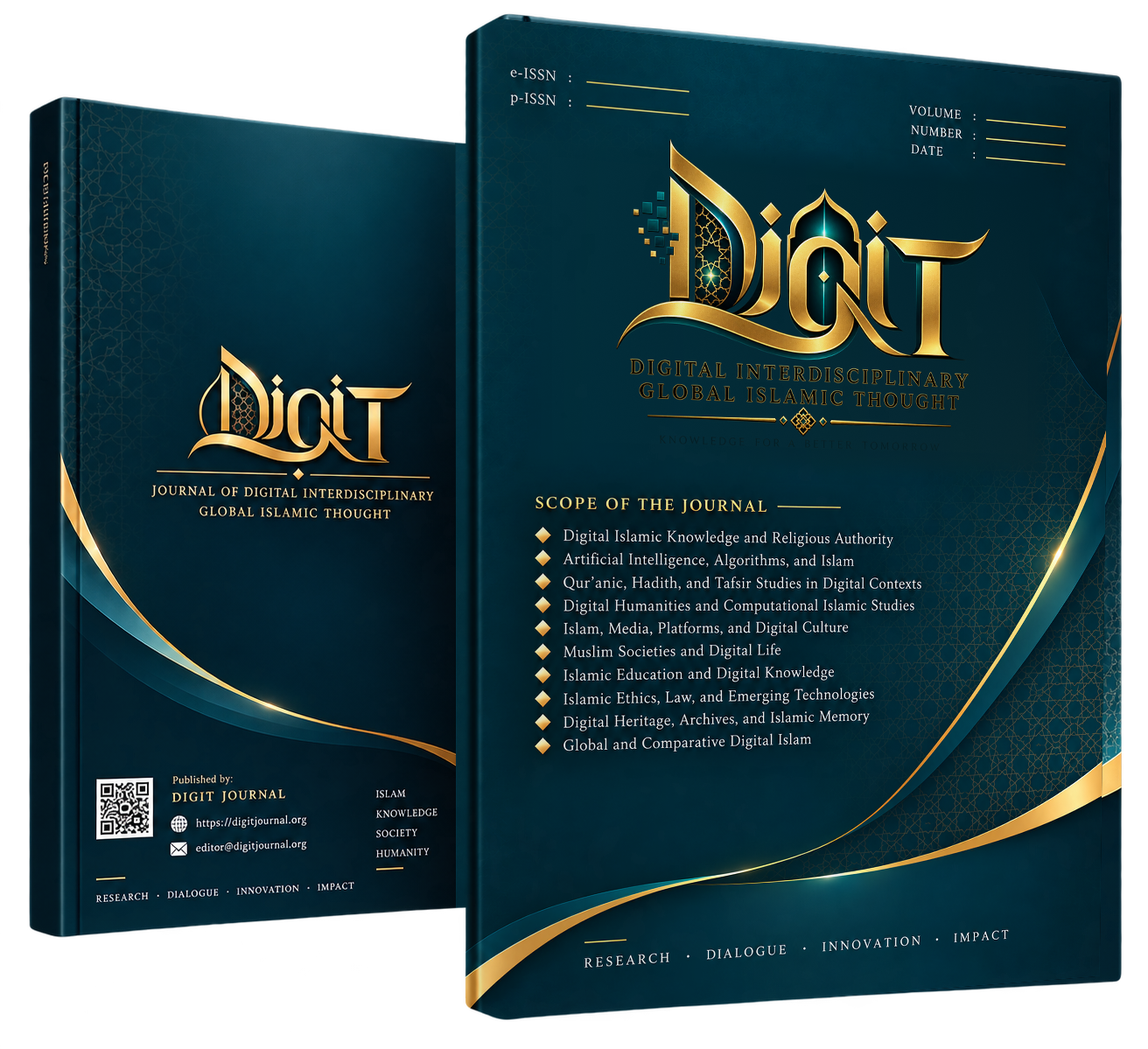
DIGIT Journal of Digital Interdisciplinary Global Islamic Thought An International Journal of Islam, Digital Culture, and Emerging Technologies
This descriptor clarifies the actual scholarly territory of the journal without changing the registered journal title.
This pre-release issue keeps seven sample article records visible so the final OJS layout can be tested and populated consistently before the journal’s first formal publication.
Sample Author 01 · [Institution] · ORCID-ready metadata
Sample Author 02 · [Institution] · Data Availability Statement
Sample Author 03 · [Institution] · Code and corpus availability
Sample Author 04 · [Institution] · ORCID-ready metadata
Sample Author 05 · [Institution] · Funding and conflict statements
Sample Author 06 · [Institution] · Review article metadata
Sample Author 07 · [Institution] · Data and preservation statement
Sample ranking retained until live usage and citation metrics are available.
Sample Author 01
Sample Author 02
Sample Author 03
Sample Author 04
Sample Author 05
Sample Author 06
Sample Author 07
Sample Author 08
Sample Author 09
Sample Author 10
[Institution], [Country / Region]
[Institution], [Country / Region]
[Institution], [Country / Region]
[Institution], [Country / Region]
[Institution], [Country / Region]
[Institution], [Country / Region]
[Institution], [Country / Region]
[Institution], [Country / Region]
[Institution], [Country / Region]
[Institution], [Country / Region]
[Institution], [Country / Region]
[Institution], [Country / Region]
[Institution], [Country / Region]
[Institution], [Country / Region]
[Institution], [Country / Region]
[Institution], [Country / Region]
Coverage values are calculated only from published articles mapped to one or more declared DIGIT scope clusters. The pie chart visualizes DIGIT's declared scope architecture; live coverage values will update automatically as published articles are added.
Country distribution is generated automatically from the affiliation and country metadata of authors in published articles.
This section updates automatically as published author metadata becomes available.
Visitor counts and country distribution update automatically from the journal’s live traffic data. Raw IP addresses are neither displayed publicly nor retained by the traffic counter.